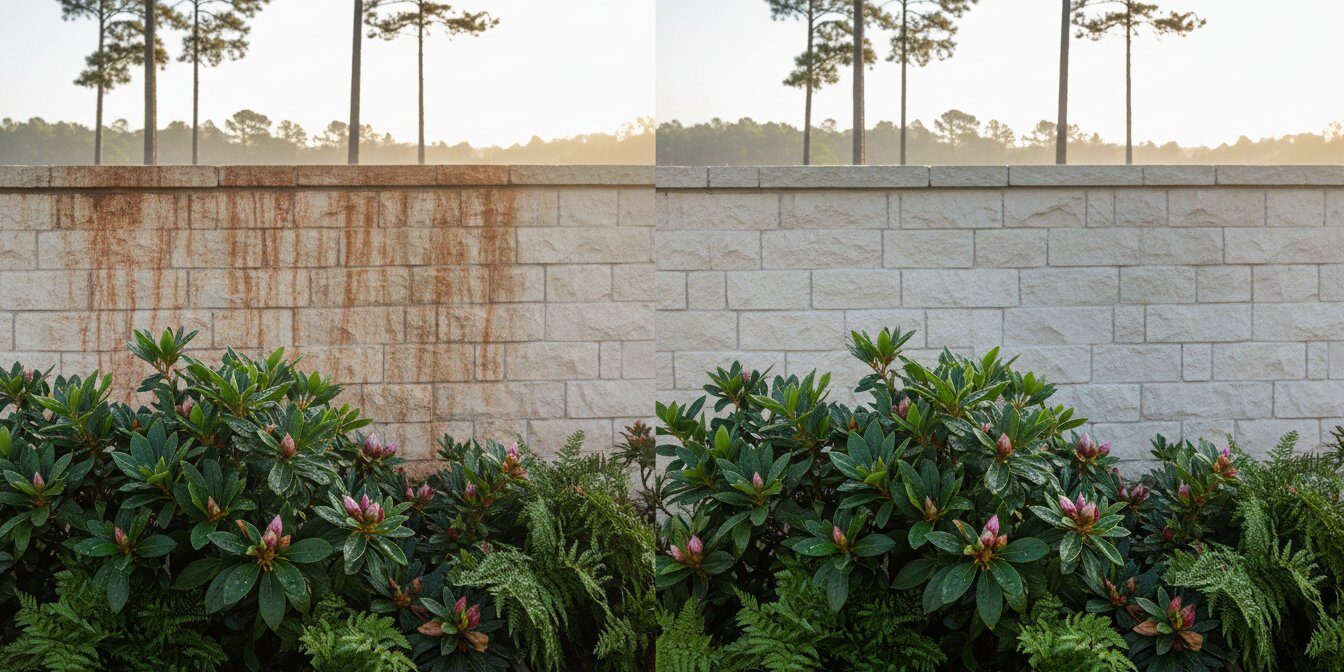
Blasting your siding with high-pressure water is often the worst way to handle the orange eyesores creeping across your property. If you’ve noticed those stubborn red streaks on your stone or vinyl, you’re likely dealing with iron oxidation from your well water. It’s frustrating to watch your curb appeal vanish, and it’s even more stressful worrying if harsh chemicals or heavy scrubbing will kill your expensive landscaping. You want to know how to remove irrigation rust stains without turning your lawn into a dead zone or etching your delicate surfaces.
We understand that your home is a major investment, and we’re here to provide the professional clarity you need to restore it safely. This guide reveals the exact chemical restoration methods used by experts to lift deep-set iron deposits while keeping your pets and plants completely secure. You’ll learn why specialized soft washing techniques outperform traditional methods and how the Poseidon Premier Maintenance Plan provides a long-term strategy to stop the orange from ever coming back. From understanding OSHA-regulated safety protocols to choosing the right restoration products, we’ll give you a clear path to a spotless, rust-free exterior.
Key Takeaways
- Understand the science behind iron oxidation and why traditional scrubbing cannot break the underlying chemical bond on your surfaces.
- Discover why high-pressure “blasting” often causes permanent surface etching and fails to lift iron particles from porous materials.
- Master the professional step-by-step process on how to remove irrigation rust stains using specialized, low-pressure restoration techniques.
- Learn how a “Plant-First” protocol ensures your expensive East Texas landscaping remains vibrant and healthy during the cleaning process.
- Explore how the Poseidon Premier Maintenance Plan prevents the inevitable return of orange stains by treating the source of the problem.
Understanding the Science of Irrigation Rust Stains
Irrigation rust stains aren’t just surface dirt. They are the result of a specific chemical reaction. When well water is pulled from the ground, it often contains dissolved ferrous iron. This iron is invisible while it’s underground. However, as soon as it hits the air through your sprinkler heads, it oxidizes. This transformation changes it into ferric iron. Understanding the science of rust is the first step in learning how to remove irrigation rust stains correctly. This chemical change creates that familiar orange pigment that bonds to everything it touches.
The Role of Well Water in Tyler, Texas
East Texas is famous for its piney woods, but the ground beneath us contains a high concentration of minerals. The aquifers in the Tyler and Longview regions are particularly rich in iron. While many homeowners have water softeners inside their homes, irrigation systems usually pull water directly from the well. This means your outdoor surfaces get a direct blast of mineral-heavy water every time the sprinklers run. You can tell it’s irrigation-induced buildup because the stains follow the spray pattern of your sprinkler heads. This differs from natural rust, which usually starts at a metal source like a nail or a hinge. For more tips on local property care, you can explore our blog.
Rust is a progressive problem. Materials like concrete, brick, and even vinyl siding are surprisingly porous. When iron-rich water hits these surfaces, the tiny iron particles sink deep into those microscopic pores. Once they oxidize and harden, they form a tight bond with the material. If you ignore these spots, they’ll only get darker and more difficult to lift. This is why a proactive approach, like the Poseidon Premier Maintenance Plan, is so effective at stopping the cycle of staining before it becomes permanent. Knowing how to remove irrigation rust stains early saves you from the headache of deep restoration later.
Why Traditional Scrubbing Fails
Many homeowners try to tackle these stains with a stiff brush and dish soap. Unfortunately, soap and water cannot dissolve a mineral deposit like iron oxide. Because the bond is chemical rather than physical, you can’t just “wash” it away. Abrasive scrubbing is also risky. Applying too much pressure to vinyl or stone can cause permanent scratches or remove the finish. This leaves your home looking worse than it did with the stains. Professional restoration requires a specific chemical balance to break that bond without damaging the substrate. We focus on these scientific methods to ensure your home looks its best without the risk of physical damage.
Why High Pressure Isn’t the Answer for Rust Removal
Many homeowners assume that high pressure is the secret to a clean exterior. They think if a stain is tough, they just need a bigger machine with more PSI. This is a common mistake. Iron in well water creates a chemical bond that high-pressure water simply cannot break. In fact, “blasting” the area often makes the problem worse. High pressure can force iron particles deeper into the pores of your concrete or brick. It also risks “etching,” which leaves permanent, jagged scars on your driveway or walkway. Once you’ve etched concrete, there’s no way to undo that physical damage.
Learning how to remove irrigation rust stains requires a shift in mindset. You’re moving from a mechanical process to a chemical one. While surface dirt sits on top of a material, iron stains are mineral deposits that have integrated with the surface. Professional-grade chemistry is the only way to safely dissolve these deposits without compromising the structural integrity of your property. Relying on force rather than science is how expensive siding and stone get ruined.
The Risk to Your Siding and Masonry
High pressure is particularly dangerous for home exteriors. A powerful stream of water can easily crack aged vinyl or strip the finish off painted wood. Even worse, it can force water behind your siding panels. This trapped moisture often leads to hidden mold growth and wood rot. In brick homes, excessive pressure can blow out mortar joints, leading to structural vulnerabilities. Our approach relies on “dwell time.” We let specialized cleaners do the heavy lifting. This gentle method is a core focus of our Poseidon Premier Maintenance Plan, ensuring your home stays beautiful without the risk of hidden damage.
Soft Washing vs. Power Washing for Iron Stains
We use a technique called soft washing for delicate areas like siding and roofs. This method uses pressure similar to a garden hose but relies on high-quality, eco-friendly cleaners to lift stains. Power washing is still useful for hard concrete surfaces, but it must be handled by an expert to avoid “zebra stripes” or uneven cleaning patterns. Professional equipment allows for a uniform finish that DIY machines can’t match. If you want to restore your home’s curb appeal without the risk, our Rust Removal services provide the specialized care your property deserves.
The Professional Priority: Safety and Plant Protection
While the previous sections focused on the chemistry of the stains, we must address the chemistry of the solution. To successfully tackle how to remove irrigation rust stains, professionals use acidic cleaners that break the chemical bond between the iron and your home’s surfaces. Research from Rutgers University explains how iron causes rust stains through groundwater oxidation. Because these cleaners are acidic, they require expert handling to ensure your surrounding landscape stays healthy. Many DIY attempts end in “dead zones” where the grass around a driveway or flowerbed turns brown because the runoff wasn’t managed properly.
Our team follows a strict “Plant-First” protocol. We don’t just start spraying. We treat your East Texas landscaping as a priority. This involves a meticulous process of pre-wetting all foliage and saturating the soil. When soil is fully hydrated, the roots are less likely to absorb any cleaning runoff. We also use specialized buffers to maintain a safe pH balance in your lawn. This level of care is a standard part of our Poseidon Premier Maintenance Plan, ensuring your curb appeal and your garden both thrive.
Our Multi-Step Plant Defense System
Protecting your property is about more than just the siding. Our defense system includes several critical steps to ensure a safe outcome. First, we flood the root zones of nearby plants with fresh water before we begin. This creates a barrier of hydration. During the application, a dedicated technician monitors and rinses greenery constantly to prevent any chemical drying on the leaves. Finally, after the rust is lifted, we apply a neutralizing agent. This ensures the runoff is safe for the environment and your soil’s natural biology. You can find more details on our specialized processes on our blog.
Safe Chemicals: What Professionals Use
Professionals typically rely on oxalic acid or phosphoric acid. These are highly effective at dissolving ferric iron but require precise dilution and application times. Off-the-shelf products from hardware stores are often either too weak to work or contain harsh additives that can permanently damage delicate stone. We ensure that every solution we use is handled according to strict safety standards. This protects not just your plants, but also local Tyler waterways. Using professional-grade equipment allows us to apply these solutions with surgical precision. This targeted approach is the most reliable way to achieve a spotless finish without the collateral damage common in amateur attempts.
The Step-by-Step Professional Removal Process
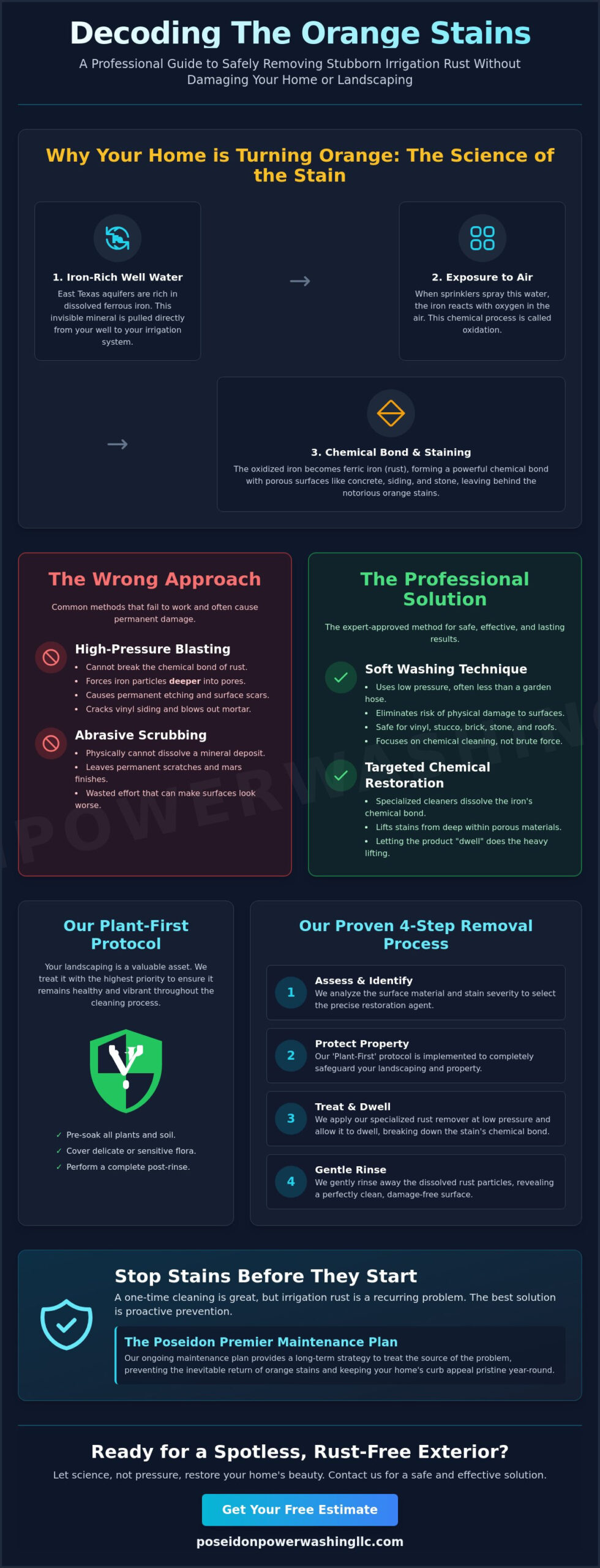
Professional restoration isn’t a one-size-fits-all job. Every property has a unique layout of stone, siding, and landscaping that dictates our approach. When we determine how to remove irrigation rust stains on a specific home, we begin with a comprehensive surface assessment. We identify the age of the material and the depth of the iron buildup to choose the correct chemical concentration. This careful planning prevents the surface damage often seen in amateur attempts. Our goal is to lift the stain while preserving the integrity of the underlying material.
Pre-Treatment and Saturation
Before any cleaning agent touches the stain, we saturate the area with fresh water. This step is critical because it prevents the cleaner from soaking too deeply into dry, porous materials, which could cause uneven “spotting” or ghosting. We also take this time to shield delicate outdoor hardware. Brass light fixtures and decorative metal handles are vulnerable to acidic mists; we mask or rinse them constantly to ensure they remain untarnished. We also monitor the surface temperature, as stone that is too hot can cause the cleaning solution to flash-dry, leading to an inconsistent finish.
Monitoring the Reaction
Next comes the precision application. Using specialized low-pressure equipment, we apply the rust-lifting agent. This isn’t a “spray and blast” situation. It’s a “spray and wait” process known as the dwell phase. During this time, the chemistry works to break the molecular bond of the iron oxide. We monitor the reaction closely, looking for a specific color shift that signals the iron is being lifted. If the solution starts to dry, we lightly re-wet the area to keep the chemistry active. For years of accumulated buildup, we may perform multiple light applications rather than one aggressive one.
The final, most important step is neutralization. We apply a solution that brings the pH level of the surface back to a neutral state. This stops the chemical reaction and ensures that no acidic residue is left behind to damage your home or the surrounding soil. This level of detail is exactly what makes our Rust Removal services a superior choice for homeowners who value their property’s longevity. Once the restoration is complete, we often discuss the Poseidon Premier Maintenance Plan. This plan is designed to prevent the cycle of staining from restarting, saving you from the need for repeated deep-cleaning sessions. Check out our blog for more insights on maintaining a pristine exterior.
Long-Term Prevention and the Poseidon Premier Maintenance Plan
Removing the orange streaks from your home is a victory, but it’s often a temporary one. If you rely on well water for your lawn, the iron is still there. It’s waiting for the next irrigation cycle to begin the oxidation process all over again. While you now know how to remove irrigation rust stains using professional methods, the most efficient way to manage your property’s appearance is to stop the stains from hardening in the first place. This is where a proactive strategy becomes essential for preserving the long-term value of your home.
Professional maintenance is the standard for high-end residential properties throughout Tyler. It ensures that your siding, stone, and concrete always look their best without the need for aggressive, emergency restoration. By catching iron buildup in its early stages, we can use even gentler methods to keep your exterior pristine. The Poseidon Premier Maintenance Plan was designed specifically to handle these recurring challenges, providing a reliable shield for your investment.
How the Poseidon Premier Maintenance Plan Works
Every property has different needs. We customize your maintenance schedule based on how often you irrigate and the specific iron levels in your local water source. This isn’t a generic service. It’s a targeted approach that saves you money by avoiding the high costs of major restorative cleaning. Members of the Poseidon Premier Maintenance Plan also benefit from priority scheduling. This is especially valuable during the peak Texas summer months when irrigation systems are running at full capacity and staining risks are at their highest.
Additional Prevention Tips for Homeowners
While professional care is the foundation of a clean home, you can take a few simple steps to minimize iron deposits between visits. Check your sprinkler heads regularly to ensure they aren’t spraying directly onto your siding, fences, or driveway. A small adjustment to the spray angle can significantly reduce the amount of iron that reaches your home’s surfaces. You might also consider rust-inhibiting water treatments that connect directly to your irrigation lines as a secondary defense. If you’re ready to clear the orange and keep it away, Schedule your professional rust removal consultation today! For more maintenance advice, feel free to browse our blog.
Restore Your Property’s Pristine Appearance
Restoring your home from iron oxidation requires more than just water and effort. It demands a scientific approach that prioritizes surface integrity and plant health. You now understand why high pressure is risky and why professional-grade chemistry is the only reliable way to handle how to remove irrigation rust stains. By choosing a partner that values safety and specialized technology, you ensure a high-quality outcome without the stress of property damage.
As a dedicated member of the Tyler, Texas business community, we bring expertise backed by annual professional certifications for all our technicians. Our team uses advanced equipment, including specialized Drone SoftWashing for high-reach stains, to deliver consistent results. Once your home is restored, the Poseidon Premier Maintenance Plan provides the ongoing care needed to keep those orange stains from returning. Don’t let mineral buildup diminish your curb appeal any longer.
Get a Free Estimate for Professional Rust Removal and let us return your home to its original beauty. We’re ready to help you protect your investment with a safe, effective restoration plan.
Frequently Asked Questions
Can irrigation rust stains be permanently removed from vinyl siding?
Professional restoration can completely lift iron deposits from vinyl siding without causing any damage. Since vinyl is less porous than brick or concrete, the chemical bond is easier to break with the right professional solutions. Our technicians provide the most reliable answer for how to remove irrigation rust stains on vinyl siding by using a low-pressure soft wash approach. This process restores the original color and luster of your home’s exterior effectively.
Will the chemicals used for rust removal kill my grass or flowers?
Your landscaping stays safe when we follow our specialized plant protection protocols. We saturate the soil and foliage with fresh water before, during, and after the application to prevent root uptake of any cleaning agents. We also apply a neutralizing agent to balance the soil’s pH levels. This meticulous care ensures that your grass and flowers remain vibrant while we work on your property’s hard surfaces.
How much does professional irrigation rust removal cost in Tyler, TX?
Professional rust removal costs are typically determined by the total surface area and the intensity of the iron buildup. While small spots might be handled as a simple add-on, larger projects require more time and specialized chemicals. You should check with a local service provider to request a custom estimate for your specific property. This ensures you receive a fair price based on the actual work required for your home.
Can I use a pressure washer to remove rust stains myself?
You shouldn’t use a pressure washer to blast away iron deposits because it often causes permanent surface etching. High pressure is a mechanical force, but the secret of how to remove irrigation rust stains lies in chemical restoration. Blasting the area can actually push iron particles deeper into the pores of your stone or concrete. Professional soft washing is the only safe way to lift these stains completely.
Why do rust stains come back so quickly after I clean them?
Rust stains reappear because your irrigation system continues to spray iron-rich well water onto your home. Every time your sprinklers run, fresh ferrous iron hits the air, oxidizes, and bonds to your siding or concrete. Without a long-term prevention strategy, the cycle of staining will restart immediately after cleaning. Addressing the water source or adjusting sprinkler heads can help slow this process down significantly.
What is the Poseidon Premier Maintenance Plan and how does it help with rust?
The Poseidon Premier Maintenance Plan is a recurring service that catches iron deposits before they harden into difficult stains. We schedule periodic maintenance washes based on your specific irrigation frequency and water mineral content. This proactive approach is much more cost-effective than waiting for heavy buildup to occur. It ensures your property maintains its high-end curb appeal throughout the peak Texas summer months when irrigation is most frequent.
Is it safe to clean rust stains if I have a pet that plays in the yard?
Our process is designed to be safe for pets and families once the final neutralization and rinsing phases are complete. We take great care to ensure no acidic residue remains on any surface or in the surrounding soil. Our technicians are trained to be meticulous with the rinsing process. Once the area is dry, your pets can safely return to playing in the yard without any concern.
How long does the professional rust removal process take for an average home?
Most residential rust removal projects are finished in two to four hours. The exact timing depends on the severity of the staining and the total square footage we need to treat. The dwell time is the most important part of the process, as the chemistry needs time to break the bond of the iron oxide. We never rush this phase because a thorough, safe clean is our top priority.